Raising a Gamer in 2026: The Honest Guide for Parents Who Didn't Sign Up for This
Raising a Gamer in 2026: The Honest Guide for Parents Who Didn't Sign Up for This
Somewhere in suburban Ohio, a parent is staring at a credit card statement trying to figure out how their nine-year-old spent $47 on "V-Bucks" while they were making dinner. In a living room in Austin, a twelve-year-old is crying because her best friend at school got the new battle pass skin and she didn't, and the season ends Friday. In a Chicago apartment, a dad is explaining to his seven-year-old why he can't accept a friend request from someone named xX_DarkReaper_Xx who is "definitely not a kid."
This is what gaming parenting looks like in 2026. Not the fun stuff — the couch co-op, the shared enthusiasm, the genuine developmental benefits that researchers have documented in everything from spatial reasoning to collaborative problem-solving. The other stuff. The stuff nobody put in the parenting books because the parenting books were written before Fortnite existed.
America's parents are navigating a gaming landscape that has fundamentally changed in the last decade, and they're largely doing it alone, armed with vague advice and incomplete tools. This is an attempt to give them something more useful.
The Live-Service Trap Nobody Warned You About
The most important thing to understand about modern gaming — the thing that changes every other conversation — is that the most popular games your kids are playing are not products. They are services. Fortnite, Roblox, Minecraft, Call of Duty, Apex Legends: these are platforms with ongoing economies, seasonal content cycles, and monetization systems that have been designed by people whose full-time job is keeping players engaged and spending.
This is not a conspiracy theory. It's a business model, and it's a legal one. But it means that when your child boots up their favorite game, they are entering an environment that has been engineered — with genuine sophistication — to create desire, manufacture urgency, and normalize spending. The battle pass that expires in eleven days. The "limited time" skin that won't come back. The friend who already has the thing your kid doesn't. These are features, not accidents.
Understanding this doesn't mean banning the games. It means going in with your eyes open.
The Real Cost of "Free"
Roblox is free. Fortnite is free. Among Us was $5. The word "free" in the gaming context has become almost meaningless as a guide to what something will actually cost a household.
The average American child who plays a major free-to-play title spends somewhere between $0 and several hundred dollars a year on in-game content, depending almost entirely on what the parents have set up — or failed to set up — on their platform accounts. According to data from the Entertainment Software Association's 2025 consumer survey, roughly 38% of US parents reported at least one unauthorized in-game purchase by a minor in the previous twelve months. The median value of those purchases was $34. The maximum reported was over $1,000.
The fix is technically simple and practically easy to overlook: every major gaming platform — PlayStation, Xbox, Nintendo Switch, Steam, Apple, Google — has parental control systems that allow spending limits and require approval for purchases. The problem is that these systems are buried in account settings, not surfaced at setup, and the default configuration on most devices is permissive rather than restrictive.
Step one for any gaming parent: set up a family account. Set a spending limit, including zero if that's your preference. Require approval for purchases. This takes about fifteen minutes and prevents the majority of accidental spending incidents before they happen.
The Battle Pass and the FOMO Economy
This one is trickier, because it's not about accidental spending — it's about deliberate social pressure.
The battle pass model, now standard across most major titles, is specifically designed to create time-limited desire. Content is available for a set period — usually around ten weeks — and then it's gone. The social dimension is intentional: kids see their friends with the new skin, the new emote, the new weapon wrap, and the absence of those items becomes visible and socially meaningful in a way that a child's brain is not well-equipped to process critically.
This creates a genuine parenting dilemma that doesn't have a clean answer. Saying no to the battle pass is a legitimate choice, but it's worth understanding that for kids in certain social groups, it carries real social consequences — the equivalent, in their peer context, of being the only kid without the right sneakers. That doesn't mean you have to buy it. But dismissing the social weight of the decision with "it's just a game" doesn't serve your kid either.
A more productive approach, recommended by several child development specialists including Dr. Linda Chen of the American Academy of Pediatrics' digital wellness working group, is to treat battle pass decisions the same way you'd treat any discretionary spending conversation: transparently. What does it cost? What do you get? Is it worth it to you? Can you earn part of it? These conversations build financial literacy alongside the immediate decision, which is a better long-term outcome than either automatic yes or unexplained no.
Online Safety: The Conversation That Can't Wait
The online multiplayer environment in 2026 is not the wild west it was a decade ago, but it is not safe by default either. Voice chat in games like Fortnite, Roblox, and Minecraft connects your child with strangers in real time, with limited moderation and significant potential for exposure to inappropriate content, harassment, and — in worst-case scenarios — predatory contact.
Roblox in particular deserves specific mention. The platform has over 70 million daily active users, a significant proportion of whom are under thirteen, and despite ongoing investment in moderation tools, the sheer scale of user-generated content means that inappropriate material regularly surfaces. The platform's parental controls are more robust than they used to be, but they require active configuration.
Practical steps that actually work:
- Voice chat off by default for children under twelve, with explicit opt-in for specific games and friend groups you know.
- Friends-only matchmaking wherever the game supports it — most major titles do.
- Regular check-ins about who they're playing with — not interrogations, just casual conversation. "Who were you playing with tonight?" is a reasonable question.
- Teach them the block and report tools before they need them. Knowing how to report inappropriate behavior is a skill, not an instinct.
The $80 Game and the Value Conversation
Base game prices hit $70 as a new standard in 2023, and some titles are now pushing $80 for standard editions. For a family with multiple gaming kids, the math gets uncomfortable fast — and that's before DLC, expansions, or the cosmetic economies layered on top.
The practical answer for most American families is some combination of subscription services and patience. Xbox Game Pass and PlayStation Plus offer substantial libraries at monthly costs that make the per-game math dramatically more favorable for households that game regularly. Sales cycles on major titles are also faster than they used to be — a $70 game from launch is frequently $30 or less within six months.
The harder conversation is about teaching kids to understand value rather than just desire. A child who learns to wait for a sale, to use a subscription library before buying, and to think critically about whether a game is worth full price is developing habits that will serve them well beyond gaming. That's a genuine upside of the current pricing environment, if you're willing to use it that way.
The Thing Nobody Talks About: When Gaming Is Actually Fine
It would be easy to read this article and conclude that gaming is a minefield best avoided. That's not the point, and it's not accurate. The research on children and gaming is considerably more nuanced than the panic-driven coverage suggests. Age-appropriate gaming in reasonable quantities has documented benefits: problem-solving skills, social connection, creative expression, and — for kids who game with parents — some of the most consistent quality family time that modern households manage to carve out.
The goal isn't to protect kids from gaming. It's to be present enough in their gaming lives to catch the problems before they become expensive, socially harmful, or unsafe. That means knowing what they're playing, who they're playing with, how the monetization works, and what the content is. Not surveillance — awareness.
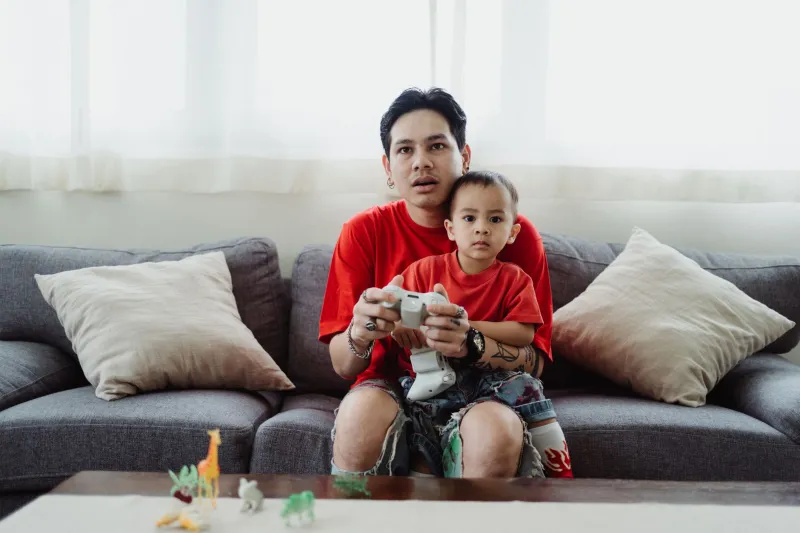
The parents who are doing this well aren't the ones who've banned screens. They're the ones who sat down, played a round of Fortnite with their kid, and asked enough questions to understand what they were actually dealing with. That's not a high bar. It's just an involved one.